
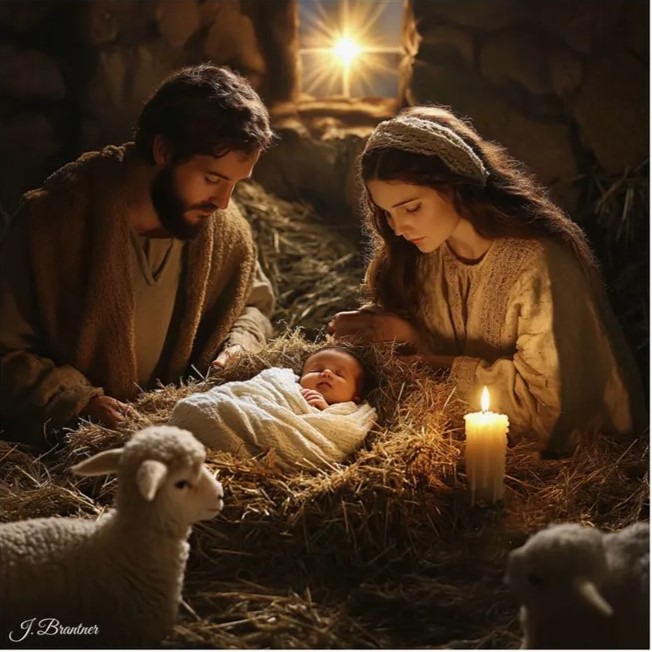
The endless debates about Christmas – birth date; trees; lights and decorations – all miss the profound truth at the heart of Christmas. The revolutionary reality we celebrate isn’t about such endless arguments – it’s about the most significant moment in human history when God took on humanity to rescue human beings from sin and divine judgment.
The Biblical Foundation
Scripture provides a comprehensive framework for understanding the rationale and purpose of Christ’s incarnation. This divine intervention was prophesied, planned, and perfectly executed according to God’s eternal purpose.
Old Testament Prophecies
The coming of Christ was foretold centuries before His birth:
- “Therefore the Lord himself shall give you a sign; Behold, a virgin shall conceive, and bear a son, and shall call his name Immanuel.” (Isaiah 7:14 circa 739-680 BCE)
- “But thou, Bethlehem Ephratah, though thou be little among the thousands of Judah, yet out of thee shall he come forth unto me that is to be ruler in Israel; whose goings forth have been from of old, from everlasting.” (Micah 5:2 circa 722 BCE)
- “For unto us a child is born, unto us a son is given: and the government shall be upon his shoulder: and his name shall be called Wonderful, Counsellor, The mighty God, The everlasting Father, The Prince of Peace.” (Isaiah 9:6 circa 739-680 BCE)
The Purpose of His Coming
Scripture clearly articulates why Christ came in human form:
- “For the Son of man is come to seek and to save that which was lost.” (Luke 19:10)
- “This is a faithful saying, and worthy of all acceptation, that Christ Jesus came into the world to save sinners.” (1 Timothy 1:15)
- “For God sent not his Son into the world to condemn the world; but that the world through him might be saved.” (John 3:17)
The Reality of Divine Judgment
The New Testament explicitly teaches about the wrath of God and the necessity of salvation:
- “For the wrath of God is revealed from heaven against all ungodliness and unrighteousness of men, who hold the truth in unrighteousness.” (Romans 1:18)
This divine judgment is not arbitrary but comes in response to human sin:
- “Let no man deceive you with vain words: for because of these things cometh the wrath of God upon the children of disobedience.” (Ephesians 5:6)
- “He that believeth on the Son hath everlasting life: and he that believeth not the Son shall not see life; but the wrath of God abideth on him.” (John 3:36)
- “For all have sinned, and come short of the glory of God.” (Romans 3:23)
The Divine Solution
But God’s purpose in Christ was redemptive:
- “For God so loved the world, that he gave his only begotten Son, that whosoever believeth in him should not perish, but have everlasting life.” (John 3:16)
- “But when the fulness of the time was come, God sent forth his Son, made of a woman, made under the law, To redeem them that were under the law.” (Galatians 4:4-5)
- “And she shall bring forth a son, and thou shalt call his name JESUS: for he shall save his people from their sins.” (Matthew 1:21)
Historical Reality, Not Mythology
The birth of Jesus isn’t relegated to the realm of myth or folklore. It’s a historical event anchored in real time and space. We know his earthly parents, Mary and Joseph. We know he was born in Bethlehem during the reign of Augustus Caesar, when Quirinius was governing Syria, and Herod the Great reigned in Jerusalem. The historical record is clear and compelling.
Even those who reject Christian beliefs – including Jewish and Muslim scholars – acknowledge Jesus as a historical figure. The evidence for His existence transcends religious boundaries and stands up to historical scrutiny.
Modern Challenges and Double Standards
In America’s current cultural landscape, Christians face unprecedented challenges in expressing and defending their faith. These challenges manifest in several distinct ways:
The Rise of Selective Skepticism
The same society that demands unquestioning acceptance of various unproven theories often applies a hypercritical standard to Christian claims. While historical evidence for Jesus’s existence is substantial and well-documented, skeptics frequently dismiss this evidence while accepting far less documented historical and scientific claims without question.
The Paradox of Modern Tolerance
Contemporary culture presents a striking contradiction in its approach to religious beliefs:
- While advocating for freedom of expression and tolerance, there’s growing intolerance toward Christian and biblical belief
- “Diversity” often excludes Christian viewpoints in academic and public discourse
- Religious expression is increasingly restricted in public arenas, except when it aligns with popular secular views
- Traditional Christian beliefs are often mis-characterized as “hate speech” rather than engaged with intellectual honesty
Academic and Educational Challenges
The academic world presents particular challenges:
- Christian perspectives are frequently marginalized in educational settings
- Historical Christian contributions to science, education, and human rights are often minimized or ignored or rejected
- Students and faculty face constant pressures to separate their faith from their academic work
- Religious viewpoints are often treated as inherently biased while secular viewpoints are presented as neutral or even intellectually authoritative
Media Representation and Public Discourse
The portrayal of Christianity in media and public discussion has become increasingly problematic:
- Christian beliefs are often caricatured rather than accurately represented
- Media coverage tends to focus on extremes rather than mainstream Christian thought
- Christians are frequently portrayed as anti-intellectual despite Christianity’s rich intellectual tradition
- Social media algorithms often suppress or flag Christian content as controversial and adversarial
The Free Speech Paradox
Perhaps most concerning is the emerging double standard in American public discourse:
- While some groups enjoy unrestricted freedom of expression, Christians face growing restrictions
- Christian perspectives on moral issues are increasingly labeled as “harmful” or “dangerous”
- Religious freedom is being redefined to mean freedom of worship only, rather than freedom of belief and expression
- Christians are expected to keep their beliefs private while other worldviews are loudly trumpeted in public arenas, news media, TV sitcoms, Hollywood’s movies, and social media, as well as both fiction and non-fiction books
Cultural Pressure and Professional Consequences
Christians increasingly face real-world consequences for their beliefs:
- Professional discrimination in certain fields
- Pressure to affirm positions that conflict with religious convictions
- Risk of legal challenges for living according to their faith
- Social ostracism for expressing traditional Biblical and Christian views
Response to These Challenges
As Christians, consider what our response should be:
- Firmly and respectfully appeal to US Constitution – Freedom of religion and Free Speech
- Maintain biblical truth while showing grace
- Engage in informed, respectful dialogue
- Support political candidates who advocate and defend religious freedom for all
- Continue to contribute positively to society
- Stand firm in faith while showing Christ’s love to all
Why This Matters
The significance of Christmas extends far beyond seasonal celebrations or religious observance. It marks the moment when the eternal entered time, when the divine took on humanity. This historical reality carries profound implications for every person, regardless of their beliefs.
So let Christmas remind us of the transforming truth . . . God became man to offer salvation to all humanity. This is the critical issue of Christmas, and it’s worth celebrating every day of the year.
When we focus on the biblical and theological significance of Christ’s birth rather than debating secondary, minor issues, we grasp the true meaning of Christmas – God’s revolutionary intervention in human history for our salvation.
#ClimbHigher #Thrive